
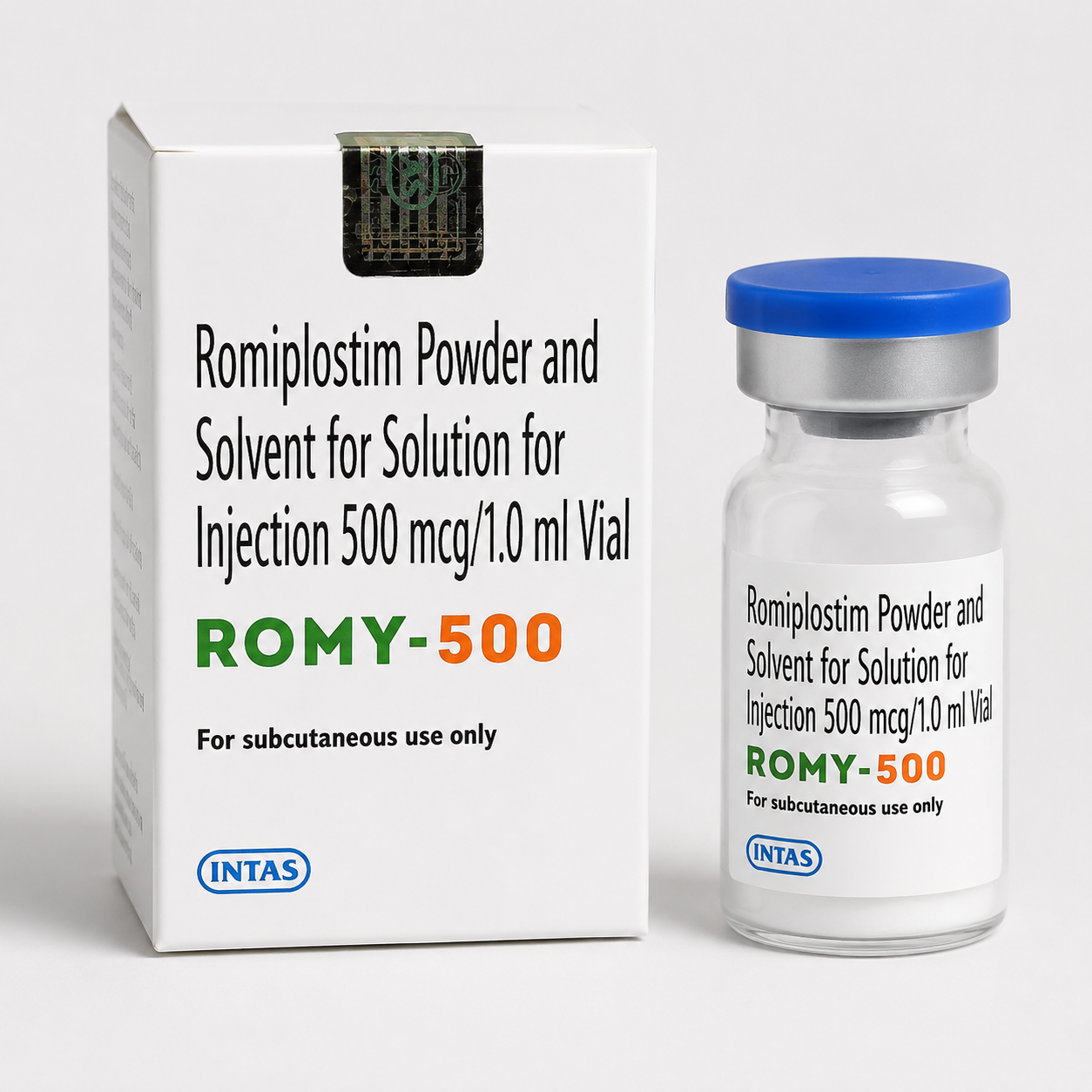
1. What is ROMY-500?
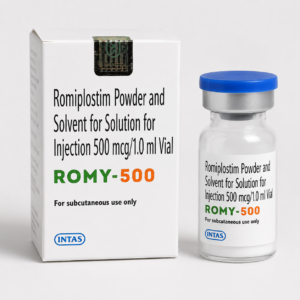
ROMY-500 is a prescription biological medicine containing romiplostim, a thrombopoietin receptor agonist. The product shown contains 500 mcg of romiplostim in a 1.0 mL deliverable volume after reconstitution and is intended for subcutaneous administration. Intas Pharmaceuticals lists ROMY (romiplostim) among its blood-related products.
Romiplostim works by stimulating the body’s thrombopoietin (TPO) receptor pathway. This encourages the bone marrow to produce more megakaryocytes, the cells responsible for producing platelets. Increasing platelet production can help raise platelet counts in appropriate patients.
ROMY-500 is indicated for chronic immune thrombocytopenia (ITP) in patients aged 1 year and older who have had an insufficient response to corticosteroids, immunoglobulins, or splenectomy, according to the Intas product information.
Doctors may prescribe romiplostim when low platelet counts associated with chronic ITP create a clinically important risk of bleeding and previous treatments have not provided adequate response. Treatment requires regular platelet-count monitoring and specialist supervision.
ROMY-500 should only be used according to the prescription of a qualified healthcare professional experienced in managing blood disorders. It should not be self-administered or used to treat unexplained low platelet counts without appropriate medical evaluation.
2. Uses of ROMY-500
ROMY-500 uses are primarily associated with the management of chronic immune thrombocytopenia (ITP).
It may be prescribed for:
- Management of chronic immune thrombocytopenia (ITP).
- Increasing platelet production in appropriate patients with chronic ITP.
- Helping maintain platelet counts at a clinically appropriate level to reduce the risk associated with significant thrombocytopenia.
- Treatment of chronic ITP when previous therapies such as corticosteroids, immunoglobulins, or splenectomy have not provided an adequate response.
Romiplostim is not intended for every cause of low platelet counts. The Intas prescribing information states that its established benefit-risk profile is for chronic ITP and that it should not be used for thrombocytopenia caused by other conditions outside clinical trials.
This medicine should only be taken or administered under the supervision of a qualified healthcare professional.
3. Benefits of ROMY-500
ROMY-500 benefits are related to its ability to stimulate platelet production in suitable patients with chronic ITP.
Potential clinical benefits include:
- Supports platelet production through stimulation of the TPO receptor.
- Helps increase platelet counts in responsive patients with chronic ITP.
- May help reduce the clinical risk associated with very low platelet counts.
- Can provide an additional treatment option when previous ITP therapies have not produced an adequate response.
- Supports ongoing management of chronic ITP when used with appropriate platelet monitoring.
The response to romiplostim differs between individuals. A higher platelet count does not necessarily mean treatment should continue at a higher level; the goal is appropriate clinical management rather than unnecessarily normalizing platelet counts.
4. How Does ROMY-500 Work?
Romiplostim belongs to a group of medicines known as thrombopoietin receptor agonists.
Platelets are blood cells that play an important role in normal clot formation. In immune thrombocytopenia, the immune system contributes to abnormally low platelet levels. Romiplostim activates the thrombopoietin receptor pathway in the bone marrow.
This stimulation promotes the development and activity of megakaryocytes, which are the cells that release platelets into the bloodstream. As platelet production increases, platelet counts may rise in patients who respond to treatment.
Because excessive platelet counts can increase the risk of blood clots, romiplostim treatment requires regular blood tests and individualized medical management.
5. How to Take ROMY-500
ROMY-500 is a subcutaneous injection and must be prepared and administered by an appropriately trained healthcare professional.
Important general guidance includes:
- Use ROMY-500 exactly as prescribed by the treating specialist.
- The treatment schedule and dose are individualized according to the patient’s condition and platelet response.
- Regular platelet-count testing is required during treatment.
- Do not change, skip, repeat, or discontinue treatment without medical advice.
- Do not attempt to prepare or inject the medicine yourself unless specifically authorized and trained by the treating healthcare team.
- If a dose is missed, contact the healthcare provider for appropriate instructions rather than trying to compensate independently.
The exact ROMY-500 dosage depends on factors including the patient’s clinical condition and platelet response, so dosing decisions must remain with the treating physician.
6. Side Effects of ROMY-500
Like all medicines, ROMY-500 may cause side effects, although not everyone experiences them.
Common Side Effects
Reported adverse reactions associated with romiplostim can include:
- Headache
- Upper respiratory tract infections
- Nausea
- Diarrhoea
- Joint or muscle pain
- Dizziness
- Injection-related or general discomfort
- Hypersensitivity reactions such as rash or hives
The Intas clinical information also reports adverse events such as nausea, headache, vomiting, fever, muscle pain and urinary discomfort in studied patients.
Serious Side Effects
Important risks requiring prompt medical assessment include:
- Blood clots or thromboembolic complications.
- Excessively increased platelet counts.
- Reappearance or worsening of thrombocytopenia and bleeding after stopping treatment.
- Hypersensitivity reactions, including angioedema.
- Changes involving bone marrow reticulin.
- Abnormal blood-cell findings requiring further evaluation.
Romiplostim can increase the risk of thrombotic or thromboembolic events when platelet counts become excessively high.
If side effects persist or become severe, contact your healthcare provider promptly.
7. Warnings and Precautions
Before treatment with ROMY-500, the doctor should know about the patient’s complete medical history.
Pregnancy and Breastfeeding
There is limited information regarding use during pregnancy. Animal studies showed placental transfer and effects on fetal platelet production. Breastfeeding decisions should be made individually with the treating healthcare professional because it is not known whether romiplostim or its metabolites are present in human milk.
Liver Disease
Romiplostim requires particular caution in patients with liver impairment because of the potential risk of thromboembolic complications, including portal vein thrombosis.
Kidney Disease
Patients with renal impairment should inform their healthcare provider. The Intas product information advises caution because formal clinical trials in these populations are limited.
Heart and Clotting Risk
Patients with a history or increased risk of blood clots should inform their doctor before treatment.
Elderly Patients
Older adults may require careful clinical assessment because individual risk factors can influence treatment decisions.
Driving
Some patients may experience dizziness. Anyone experiencing dizziness should discuss driving or operating machinery with a healthcare professional.
Allergies
ROMY-500 should not be used in people with known hypersensitivity to romiplostim, its ingredients, or relevant E. coli-derived proteins.
8. Drug Interactions
The interaction profile of romiplostim is not completely established. Patients should tell their healthcare provider about all medicines they use, including:
- Prescription medicines
- Over-the-counter medicines
- Corticosteroids
- Immunoglobulins
- Antiplatelet medicines
- Anticoagulants
- Vitamins
- Herbal or dietary supplements
Romiplostim has been used alongside certain ITP treatments in clinical studies, but platelet counts need to be monitored when therapies are combined or changed.
Do not start, stop, or change another medicine without medical advice.
9. Storage Instructions
ROMY-500 is a biologic medicine that requires appropriate storage and handling.
General storage guidance includes:
- Store the unopened product under the temperature conditions specified on the product packaging and prescribing information.
- Protect the medicine from inappropriate heat and light exposure.
- Keep it out of reach of children.
- Do not use the product after its expiry date.
- Reconstituted medicine should be handled according to the manufacturer’s instructions and healthcare-facility procedures.
The Intas product information states a shelf life of 36 months when stored at 2°C–8°C and provides specific conditions for the reconstituted product.
10. Disclaimer
This ROMY-500 product description is provided for educational and informational purposes only. It is not a substitute for professional medical advice, diagnosis, or treatment.
ROMY-500 is a prescription medicine and should not be self-medicated. Treatment decisions, monitoring, dose adjustments, preparation, and administration should be handled by an appropriately qualified healthcare professional. Individual responses and risks may vary depending on the patient’s condition, medical history, laboratory results, and other medicines being used.
For authoritative prescribing information, healthcare professionals should consult the current product information and applicable local medical guidance.
11. Frequently Asked Questions
1. What is ROMY-500 used for?
ROMY-500 contains romiplostim and is indicated for chronic immune thrombocytopenia (ITP) in eligible patients who have not responded adequately to treatments such as corticosteroids, immunoglobulins, or splenectomy. It works by stimulating platelet production in the bone marrow.
2. How does ROMY-500 work?
ROMY-500 contains romiplostim, a thrombopoietin receptor agonist. It activates the TPO receptor pathway in the bone marrow, encouraging megakaryocyte development and platelet production. This can increase platelet counts in patients with chronic ITP who respond to treatment.
3. Is ROMY-500 safe?
ROMY-500 can be an appropriate treatment for selected patients with chronic ITP when prescribed and monitored by a specialist. However, it can cause important adverse effects, including excessive platelet elevation and thromboembolic complications. Regular monitoring is therefore essential.
4. Can ROMY-500 be used long term?
Romiplostim may be used as part of longer-term management of chronic ITP when the treating physician considers continued treatment appropriate. Ongoing platelet monitoring and periodic clinical assessment are important because the response and risks can change over time.
5. What happens if I miss a ROMY-500 dose?
Because ROMY-500 is a specialist-administered injection, a missed dose should be discussed with the treating healthcare provider. Do not attempt to compensate for a missed dose by receiving an additional injection without medical instructions.
6. Can I stop ROMY-500 suddenly?
Treatment should not be stopped independently. Platelet counts can fall again after romiplostim is discontinued, and the risk of bleeding may increase. The treating physician should determine whether and how treatment should be discontinued and what monitoring or alternative management is required.
7. Can ROMY-500 be taken with food?
ROMY-500 is not an oral medicine. It is supplied as a powder and solvent for solution and is administered by subcutaneous injection after appropriate preparation. Therefore, food does not determine how this injection is administered.
8. What are the common ROMY-500 side effects?
Reported side effects of romiplostim include headache, nausea, diarrhoea, upper respiratory infections, muscle or joint pain and hypersensitivity reactions. Individual experiences vary, and any persistent, severe, or unusual symptoms should be reported to the healthcare provider.
9. Who should avoid ROMY-500?
ROMY-500 should not be used by people with known hypersensitivity to romiplostim, its excipients, or relevant E. coli-derived proteins. It also should not be used for unexplained thrombocytopenia or conditions for which its benefit-risk profile has not been established.
10. How should ROMY-500 be stored?
The unopened product should be stored according to the manufacturer’s specified conditions. Intas product information states storage at 2°C–8°C for the specified shelf-life and provides additional instructions for the reconstituted product. Healthcare professionals should follow the current product insert for handling requirements.
Important Note
Searches for terms such as ROMY-500 price, ROMY-500 dosage, or buy ROMY-500 online should not replace advice from a qualified healthcare professional. Because ROMY-500 is a prescription biological medicine requiring specialist preparation, administration, and platelet monitoring, treatment should be obtained and managed through appropriate medical care.

Reviews
There are no reviews yet.